 Add to Chrome
 Add to Firefox
 Add to Edge
Rethinking Literature Search Evaluation: Deep Research Helps, and Human Citation Lists Are Not a Ground Truth
May 28, 2026
We study large-scale literature search from two complementary angles: improving the retrieval pipeline, and stress-testing the human reference list as an evaluation target. First, we implement a Deep Research pipeline that processes the full query paper and expands the retrieved results breadth-first along their bibliographies, and show that it substantially outperforms vanilla API-only search, raising recall on RollingEval-Jun25 (a 250-paper literature-search benchmark) from below 20% to above 80%. Second, we use a neutral LLM-as-a-judge to determine if human references are sound ground truth for the task. We find significant limitations: only 51% of human citations are judged moderately relevant or higher, against 86--88% for the strongest AI-based re-rankers. We study this gap on the OpenAlex co-authorship graph, finding that humans are 2.5x more likely than the best AI re-rankers to cite a direct collaborator. Together, our results argue against single-axis literature-search evaluation: recall, topical-relevance scoring, ranked-list diversity, and a co-authorship-distance diagnostic each measure complementary properties of citation quality and should be reported jointly.

Affective Music Recommendation: A Rollout-Based World Model for Offline Preference Optimization
May 27, 2026Functional music applications, from consumer focus and sleep aids to clinical interventions, share a distinctive recommendation problem: success is defined by the listener's affective state, but online experimentation on emotion is ethically constrained, particularly for clinical populations who cannot reliably skip a song or report distress. We describe AMRS, the Affective Music Recommendation System deployed on LUCID's health-and-wellness platforms, which serve clinical users (primarily older adults with neurocognitive conditions) and consumer-wellness users across energize, focus, calm, and sleep modes. AMRS is built around a rollout-based world model: a causal transformer trained on logged listening data to jointly predict engagement, binary rating, and self-reported valence and arousal. The world model serves both as an in-silico simulator for offline policy training and as a stress-testing tool before deployment. A recommender policy initialized by behaviour cloning is fine-tuned offline with Direct Preference Optimization (DPO) against a configurable multi-objective utility function. Under a strict cold-start protocol, the world model predicts both behavioural and affective signals with usable fidelity; DPO improves predicted valence and arousal over the cloned baseline while maintaining a similar diversity profile and avoiding the distributional collapse produced by greedy optimization. We position the work as an early deployed validation of a methodology for affective recommendation when online experimentation is ethically untenable.
Contextual Preference Distribution Learning
Mar 17, 2026Decision-making problems often feature uncertainty stemming from heterogeneous and context-dependent human preferences. To address this, we propose a sequential learning-and-optimization pipeline to learn preference distributions and leverage them to solve downstream problems, for example risk-averse formulations. We focus on human choice settings that can be formulated as (integer) linear programs. In such settings, existing inverse optimization and choice modelling methods infer preferences from observed choices but typically produce point estimates or fail to capture contextual shifts, making them unsuitable for risk-averse decision-making. Using a bounded-variance score function gradient estimator, we train a predictive model mapping contextual features to a rich class of parameterizable distributions. This approach yields a maximum likelihood estimate. The model generates scenarios for unseen contexts in the subsequent optimization phase. In a synthetic ridesharing environment, our approach reduces average post-decision surprise by up to 114$\times$ compared to a risk-neutral approach with perfect predictions and up to 25$\times$ compared to leading risk-averse baselines.
Modular Memory is the Key to Continual Learning Agents
Mar 02, 2026Foundation models have transformed machine learning through large-scale pretraining and increased test-time compute. Despite surpassing human performance in several domains, these models remain fundamentally limited in continuous operation, experience accumulation, and personalization, capabilities that are central to adaptive intelligence. While continual learning research has long targeted these goals, its historical focus on in-weight learning (IWL), i.e., updating a single model's parameters to absorb new knowledge, has rendered catastrophic forgetting a persistent challenge. Our position is that combining the strengths of In-Weight Learning (IWL) and the newly emerged capabilities of In-Context Learning (ICL) through the design of modular memory is the missing piece for continual adaptation at scale. We outline a conceptual framework for modular memory-centric architectures that leverage ICL for rapid adaptation and knowledge accumulation, and IWL for stable updates to model capabilities, charting a practical roadmap toward continually learning agents.
Privileged Information Distillation for Language Models
Feb 04, 2026Training-time privileged information (PI) can enable language models to succeed on tasks they would otherwise fail, making it a powerful tool for reinforcement learning in hard, long-horizon settings. However, transferring capabilities learned with PI to policies that must act without it at inference time remains a fundamental challenge. We study this problem in the context of distilling frontier models for multi-turn agentic environments, where closed-source systems typically hide their internal reasoning and expose only action trajectories. This breaks standard distillation pipelines, since successful behavior is observable but the reasoning process is not. For this, we introduce π-Distill, a joint teacher-student objective that trains a PI-conditioned teacher and an unconditioned student simultaneously using the same model. Additionally, we also introduce On-Policy Self-Distillation (OPSD), an alternative approach that trains using Reinforcement Learning (RL) with a reverse KL-penalty between the student and the PI-conditioned teacher. We show that both of these algorithms effectively distill frontier agents using action-only PI. Specifically we find that π-Distill and in some cases OPSD, outperform industry standard practices (Supervised finetuning followed by RL) that assume access to full Chain-of-Thought supervision across multiple agentic benchmarks, models, and forms of PI. We complement our results with extensive analysis that characterizes the factors enabling effective learning with PI, focusing primarily on π-Distill and characterizing when OPSD is competitive.
Self-Supervised Learning from Structural Invariance
Feb 02, 2026Joint-embedding self-supervised learning (SSL), the key paradigm for unsupervised representation learning from visual data, learns from invariances between semantically-related data pairs. We study the one-to-many mapping problem in SSL, where each datum may be mapped to multiple valid targets. This arises when data pairs come from naturally occurring generative processes, e.g., successive video frames. We show that existing methods struggle to flexibly capture this conditional uncertainty. As a remedy, we introduce a latent variable to account for this uncertainty and derive a variational lower bound on the mutual information between paired embeddings. Our derivation yields a simple regularization term for standard SSL objectives. The resulting method, which we call AdaSSL, applies to both contrastive and distillation-based SSL objectives, and we empirically show its versatility in causal representation learning, fine-grained image understanding, and world modeling on videos.
Optimizing User Profiles via Contextual Bandits for Retrieval-Augmented LLM Personalization
Jan 17, 2026Large Language Models (LLMs) excel at general-purpose tasks, yet adapting their responses to individual users remains challenging. Retrieval augmentation provides a lightweight alternative to fine-tuning by conditioning LLMs on user history records, and existing approaches typically select these records based on semantic relevance. We argue that relevance serves as an unreliable proxy for utility: a record may be semantically similar to a query yet fail to improve generation quality or even degrade it due to redundancy or conflicting information. To bridge this gap, we propose PURPLE, a contextual bandit framework that oPtimizes UseR Profiles for Llm pErsonalization. In contrast to a greedy selection of the most relevant records, PURPLE treats profile construction as a set generation process and utilizes a Plackett-Luce ranking model to capture complex inter-record dependencies. By training with dense feedback provided by the likelihood of the reference response, our method aligns retrieval directly with generation quality. Extensive experiments on nine personalization tasks demonstrate that PURPLE consistently outperforms strong heuristic and retrieval-augmented baselines in both effectiveness and efficiency, establishing a principled and scalable solution for optimizing user profiles.
Audio Prototypical Network For Controllable Music Recommendation
Jul 31, 2025Traditional recommendation systems represent user preferences in dense representations obtained through black-box encoder models. While these models often provide strong recommendation performance, they lack interpretability for users, leaving users unable to understand or control the system's modeling of their preferences. This limitation is especially challenging in music recommendation, where user preferences are highly personal and often evolve based on nuanced qualities like mood, genre, tempo, or instrumentation. In this paper, we propose an audio prototypical network for controllable music recommendation. This network expresses user preferences in terms of prototypes representative of semantically meaningful features pertaining to musical qualities. We show that the model obtains competitive recommendation performance compared to popular baseline models while also providing interpretable and controllable user profiles.
Addressing Concept Mislabeling in Concept Bottleneck Models Through Preference Optimization
Apr 25, 2025Concept Bottleneck Models (CBMs) propose to enhance the trustworthiness of AI systems by constraining their decisions on a set of human understandable concepts. However, CBMs typically assume that datasets contains accurate concept labels an assumption often violated in practice, which we show can significantly degrade performance (by 25% in some cases). To address this, we introduce the Concept Preference Optimization (CPO) objective, a new loss function based on Direct Preference Optimization, which effectively mitigates the negative impact of concept mislabeling on CBM performance. We provide an analysis on some key properties of the CPO objective showing it directly optimizes for the concept's posterior distribution, and contrast it against Binary Cross Entropy (BCE) where we show CPO is inherently less sensitive to concept noise. We empirically confirm our analysis finding that CPO consistently outperforms BCE in three real world datasets with and without added label noise.
LLMs for Literature Review: Are we there yet?
Dec 15, 2024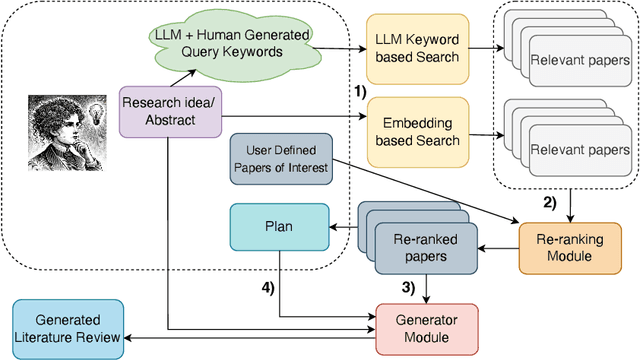
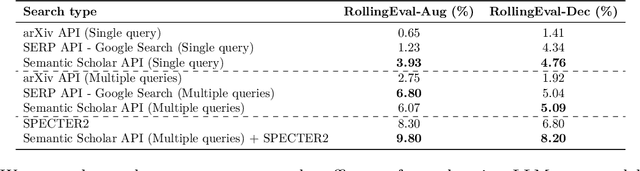
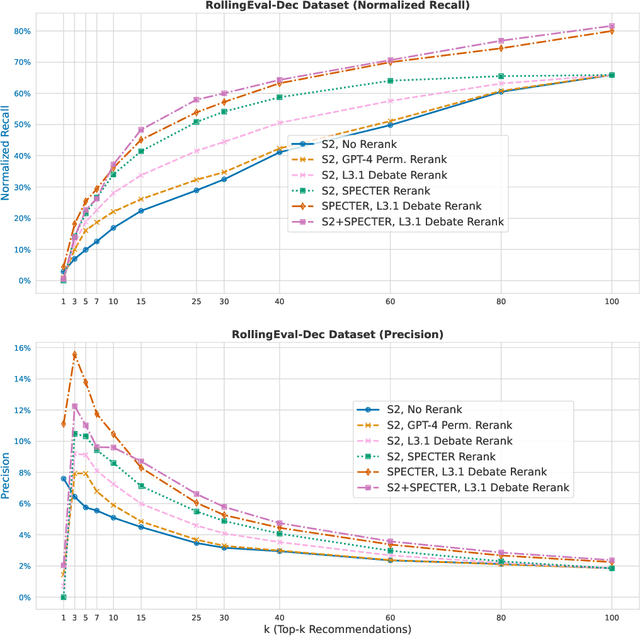

Literature reviews are an essential component of scientific research, but they remain time-intensive and challenging to write, especially due to the recent influx of research papers. This paper explores the zero-shot abilities of recent Large Language Models (LLMs) in assisting with the writing of literature reviews based on an abstract. We decompose the task into two components: 1. Retrieving related works given a query abstract, and 2. Writing a literature review based on the retrieved results. We analyze how effective LLMs are for both components. For retrieval, we introduce a novel two-step search strategy that first uses an LLM to extract meaningful keywords from the abstract of a paper and then retrieves potentially relevant papers by querying an external knowledge base. Additionally, we study a prompting-based re-ranking mechanism with attribution and show that re-ranking doubles the normalized recall compared to naive search methods, while providing insights into the LLM's decision-making process. In the generation phase, we propose a two-step approach that first outlines a plan for the review and then executes steps in the plan to generate the actual review. To evaluate different LLM-based literature review methods, we create test sets from arXiv papers using a protocol designed for rolling use with newly released LLMs to avoid test set contamination in zero-shot evaluations. We release this evaluation protocol to promote additional research and development in this regard. Our empirical results suggest that LLMs show promising potential for writing literature reviews when the task is decomposed into smaller components of retrieval and planning. Further, we demonstrate that our planning-based approach achieves higher-quality reviews by minimizing hallucinated references in the generated review by 18-26% compared to existing simpler LLM-based generation methods.